
From Flooded Streets to Fondou
Before he owned a café in central Auckland, Jerry sold firecrackers from his childhood aguinaldo (Christmas money), spent eight years working in Korea, grew a small gym venture in the Philippines and rebuilt his confidence in a country where even the word “rubbish” could be misunderstood.
The job sounded confusing from the start.
Newly arrived in New Zealand and still uneasy speaking English, Jerry had accepted temporary work while waiting for a more permanent role. The crew travelled to a hilly worksite. He put on his protective equipment and followed the others into an area filled with rubbish.
Only then did Jerry understand what he had agreed to do: collect the loose waste that the wind carried across the site before it spread farther.
During the interview, however, “rubbish” had sounded like “radish.”
“Sabi ko sa sarili ko, ‘Galing akong Korea, gagawin ko naman iyong radish na iyon.’”
At the time, it revealed a deeper struggle. After eight years working in Korea, Jerry had arrived in New Zealand ready to work but afraid that his English would fail him. The local accent felt unfamiliar. Job interviews made him nervous. When he heard English spoken around him, his instinct was sometimes to step away rather than join the conversation.
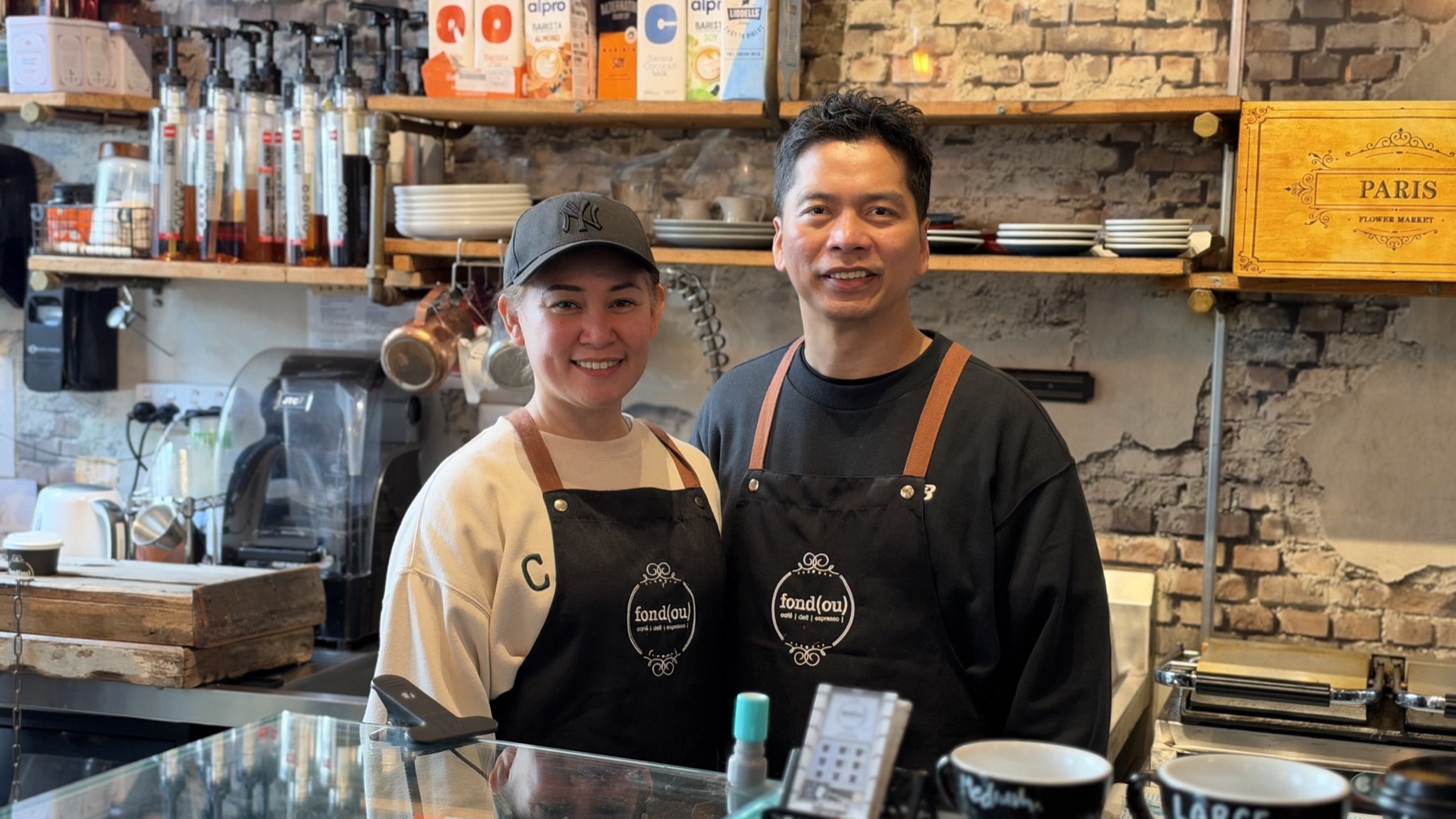
Years later, Jerry would be the one welcoming customers across the counter at Fondou Cafe in central Auckland.
The distance between those two moments was built on a habit he learned long before migration: when life becomes difficult, keep moving.
Where Business Began
Jerry grew up in Pampanga as one of four siblings. His family had a small neighbourhood shop. After his father died, his mother supported the family while running a demanding trade: buying seafood in Pampanga and travelling to Novaliches to sell it.
Jerry helped where he could. Business was not an abstract subject taught in a classroom; it was something he saw his mother do every day.
Life in their community was difficult, particularly during the rainy season. Flooding was common. Buying stock for the family shop could mean walking several kilometres to town. When the water rose, the family sometimes travelled by boat.
“Doon ako talagang nahasa na magsumikap,” Jerry says. That was where he learned persistence.
The instinct to trade appeared early. Instead of spending all the money he received as aguinaldo, the young Jerry bought firecrackers and resold them through the family shop.
“Bata pa lang ako, mahilig na akong magtinda,” he says. “Gusto kong matuto nang matuto sa negosyo.”
Eight Years Away—and a Chance to Reunite
As an adult, Jerry left the Philippines and worked in Korea for eight years. The work created opportunity, but the separation carried a cost: he could not bring his family to live with him.
New Zealand offered something Korea had not—the chance for the family to build a life together.
Jerry credits his wife with taking the first step. Once she came to New Zealand, the path opened for the rest of the family to reunite.
“Doon kami nag-build talaga na ang family ay together,” he says. For Jerry, the move was not simply about finding another job overseas. It was about finally living as one household again.
Starting over still required humility. He had to navigate recruitment agents, interviews and a way of speaking English that felt different from what he knew. The “radish” and “rubbish” mix-up became one memorable example of the gap he was trying to cross.
Yet Jerry kept accepting work, listening and learning. The confidence came later.
One Gym Became Three
Even while employed in Korea, Jerry had continued thinking like a business owner.
When someone offered a gym business for sale in the Philippines, he bought it and paid for it gradually from his overseas earnings. The first gym earned only a little at the beginning, but Jerry reinvested what it made. Income from one helped pay for the next, while his wages in Korea helped fill the gap.
Eventually, the venture grew to three gyms.
That experience reinforced a lesson first learned from his mother's market business: a modest beginning can become something larger when its earnings are returned to the work.
After arriving in New Zealand, Jerry again began as an employee. An opportunity in carpeting taught him practical flooring skills, and a friend showed him how to turn those skills into a business. After the COVID-19 period, Jerry moved into renovation work, concentrating on carpet, vinyl and other flooring jobs, including work in public housing properties.
The business was established. But another ambition remained.
Jerry wanted a coffee shop.
Preparing for the Dream
In 2024, Jerry trained as a barista. After completing a course, he arranged private coaching to learn the foundations more deeply.
Then he started looking for premises.
Friends and agents helped him inspect possible sites, but none felt right. The search slowed until an ordinary encounter at badminton changed its direction.
Jerry was walking in as another Filipino, Jerome, was walking out. They greeted each other and began talking. Jerome worked in hospitality and mentioned that he had a restaurant and a café. Jerry explained that he was in renovation—and that he had been looking for a café.
The coincidence stopped him.
“Parang kinilabutan ako. Ito yata iyong binibigay ni Lord.”
They exchanged numbers on a Monday. Jerry waited through Tuesday. By Wednesday, Jerome finally called.
Jerry went to see Fondou Cafe at 157 Hobson Street, a small café tucked into Auckland's city centre. Public listings describe it as a breakfast and lunch spot serving coffee, baked goods, bagels, toasties and other cabinet food.
The feeling was immediate.
“Ang luwag sa pakiramdam,” Jerry says. “Ito yata iyong binibigay ni Lord.”
But he would not make the decision alone. He wanted his wife's full support. They returned together on Friday, and she liked the café too.
The couple prayed about the decision. If the transaction moved smoothly, they would take that as their answer. Jerry and Jerome agreed on a price, and a long-held ambition became a real business.
The Work Behind the Display Cabinet
To a customer, a café can look simple: walk in, choose something from the cabinet, order a coffee and carry on with the day.
Jerry sees everything that has to happen before that moment.
There is stock to buy, orders to place and food to prepare for the following morning. When an ingredient is unavailable, somebody must find it elsewhere. The work begins before customers arrive so the display is ready when the doors open.
“Iyon ang hindi nakikita ng mga tao,” Jerry says. “Mas maraming ginagawa sa likod noon.”
For him, ownership did not replace hard work with freedom. It changed the kind of work—and made preparation even more important.
Two Businesses, One Clock
Fondou did not become Jerry's only responsibility. He was still running his renovation work, and the two businesses competed for the same limited hours.
The café demanded early mornings. Renovation jobs waited afterwards. In the beginning, Jerry sometimes stayed too long at Fondou and realised that he still had flooring work to complete.
His solution was not dramatic. He began setting firmer boundaries for himself: a time to wake, a time to finish the café work and a time to move to renovation projects.
Time management became the system holding both businesses together.
The discipline echoes the rhythm of Jerry's childhood. His mother bought seafood in one place and sold it in another. The family walked kilometres for stock, or crossed floodwater by boat, so their small shop could keep serving its neighbours. Every sale depended on work the customer never saw.
At Fondou, the product has changed. The principle has not.
Jerry's journey is not a simple story of arriving overseas and finding success. It is a story of beginning repeatedly: as a child vendor in Pampanga, an overseas worker in Korea, a nervous newcomer in New Zealand, a flooring tradesman, a renovation business owner and, finally, a barista behind his own counter.
The boy who used his Christmas money to buy something he could resell never really disappeared. He simply learned new products, new industries and a new language—one misunderstood word at a time.